One AI agent is a productivity tool. A fleet of them is a governance problem.
Journi DevOS turns that problem into a capability: one control plane over Claude Code, Codex and every agent your team runs — governed, equipped and measured, inside your perimeter and at lower cost.
Illustrative figures from DevOS benchmark runs on public repositories. Your results vary with your codebase and workflow.
AI showed up faster than the guardrails.
AI coding took off bottom-up — one developer, one agent at a time. Great for individual speed, a problem for the organisation: three gaps open up, and they widen with every new seat.
Everyone picks their own
Every developer chooses their own agent, model and settings. No shared policy, no view of what's going to which provider, no way to hold a standard. Shadow AI, one repo at a time.
Knowledge evaporates
What each agent learns dies with the session. The same architecture gets re-explained a thousand times, and the context one developer built never reaches the next.
Spend without a story
The bill climbs; the velocity story is anecdotal. Nobody can tell leadership what AI actually returns — or whether any of it is safe.
Stop managing agents one developer at a time. Put a layer over all of them.
Journi DevOS sits between your developers' agents and your code — one control plane that governs, equips and measures every session, across the tools they already run.
One layer, every agent
Claude Code, Codex and more, under a single control plane. Standardise on policy, not on a vendor's IDE — your developers keep the agent they already chose.
Set the standard once
Policy, vetted skills and shared memory, defined centrally and applied everywhere, so every agent works to the same bar.
Prove the value, price the savings
Every gain measured against a no-DevOS baseline and priced into a statement finance trusts — next to delivery metrics that show what AI actually returns.
One control plane between your agents and your code.
Your developers keep their agents. Journi DevOS governs, grounds and measures every session — and runs entirely inside your own perimeter.
Private by default. Nothing leaves unless you opt in.
Everything you need to run AI coding as a capability.
Four pillars, one platform — governed centrally, measured end to end, across the agents you already run.
Set policy once. It reaches every agent.
One org baseline every team inherits, with stricter limits where you need them. Allowed models, budgets and consent floors — all on an auditable trail.
Explore Polaris →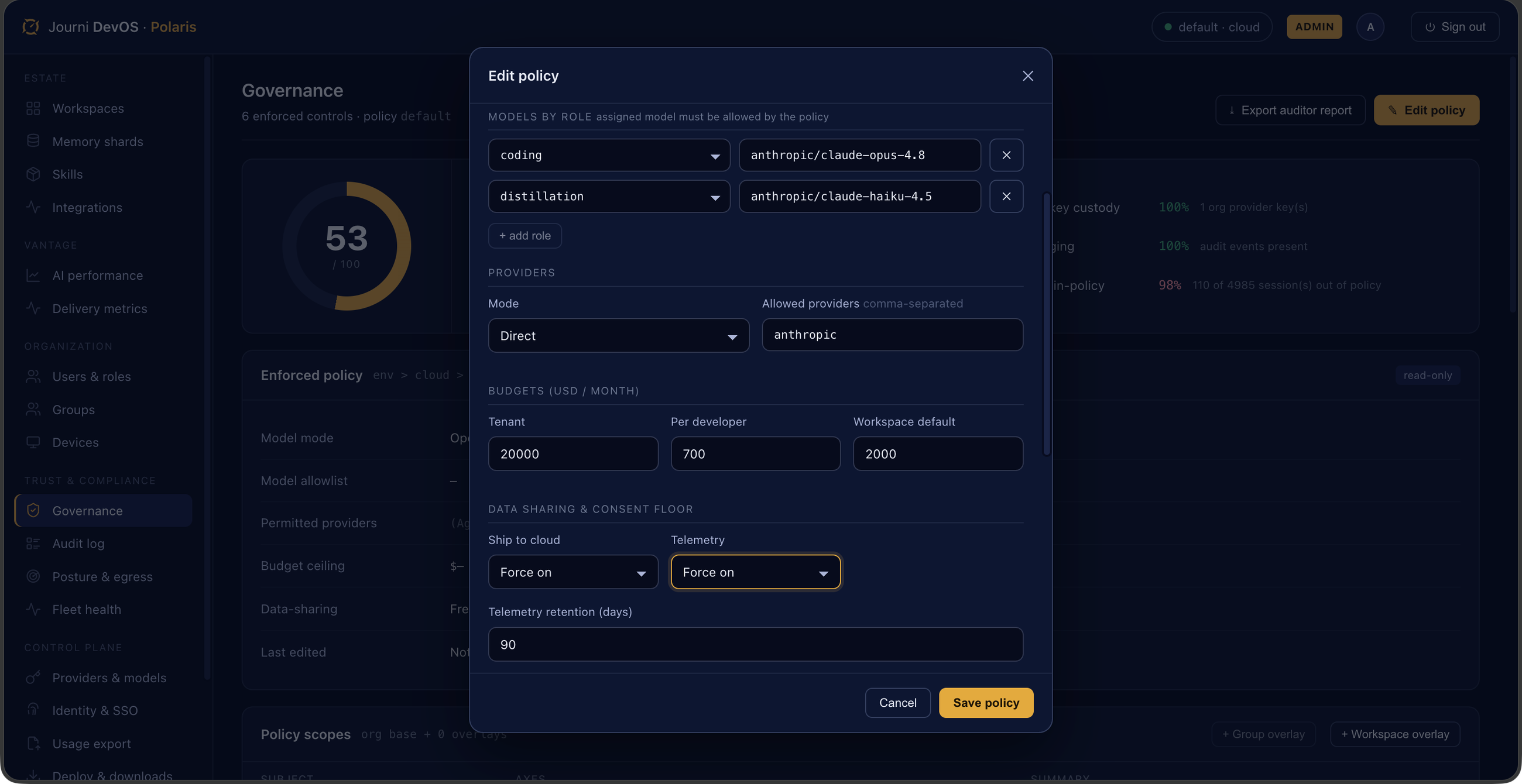
Knowledge compounds instead of evaporating.
A shared, provenance-graded memory built from your repos — current as you commit, with restricted shards and group-scoped access.
Explore Almanac →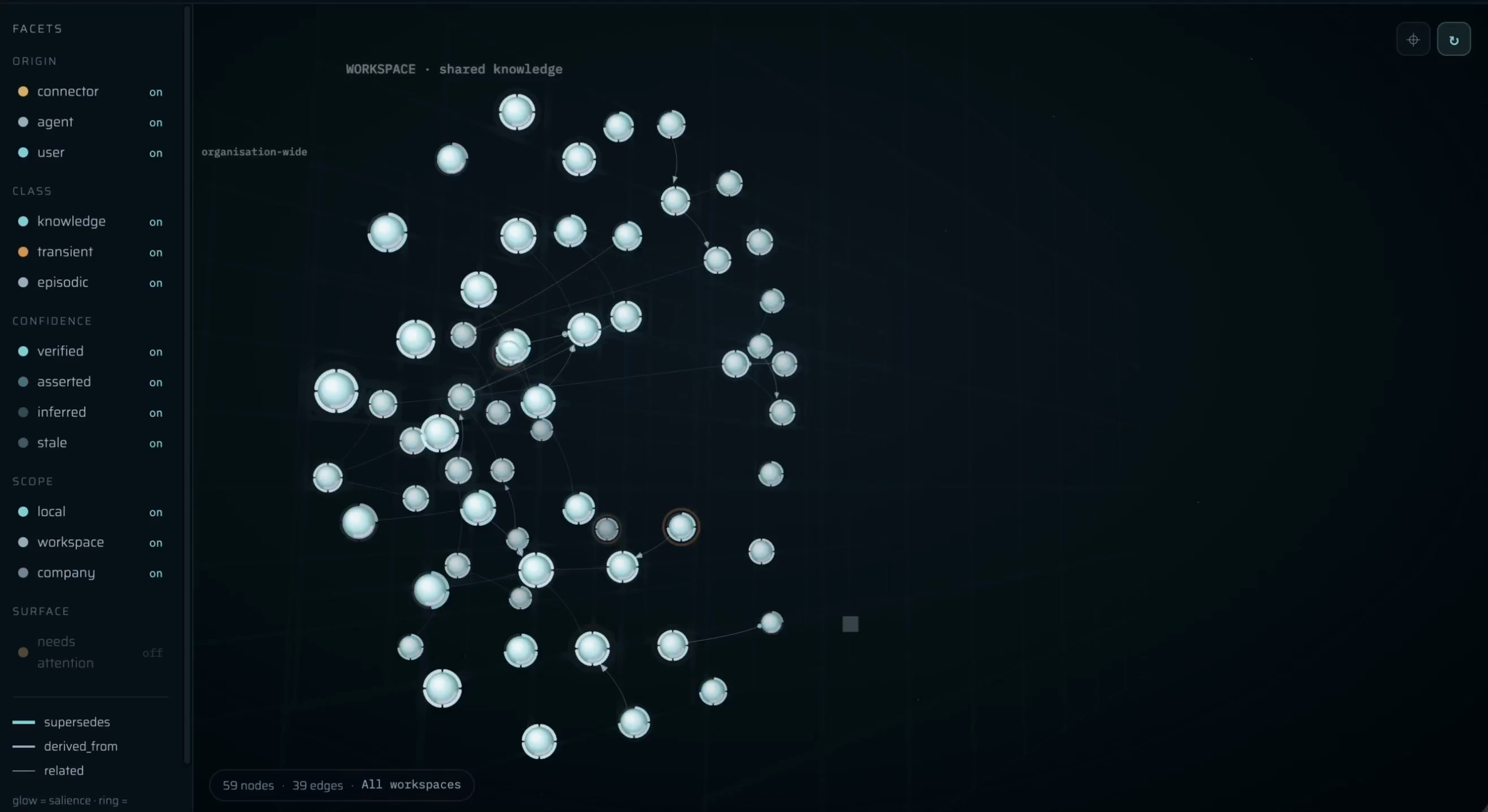
Your best practices, shipped to every agent.
An internal skills marketplace: author, review, approve — then distribute to the fleet by policy, content-addressed and audited.
Explore Skills →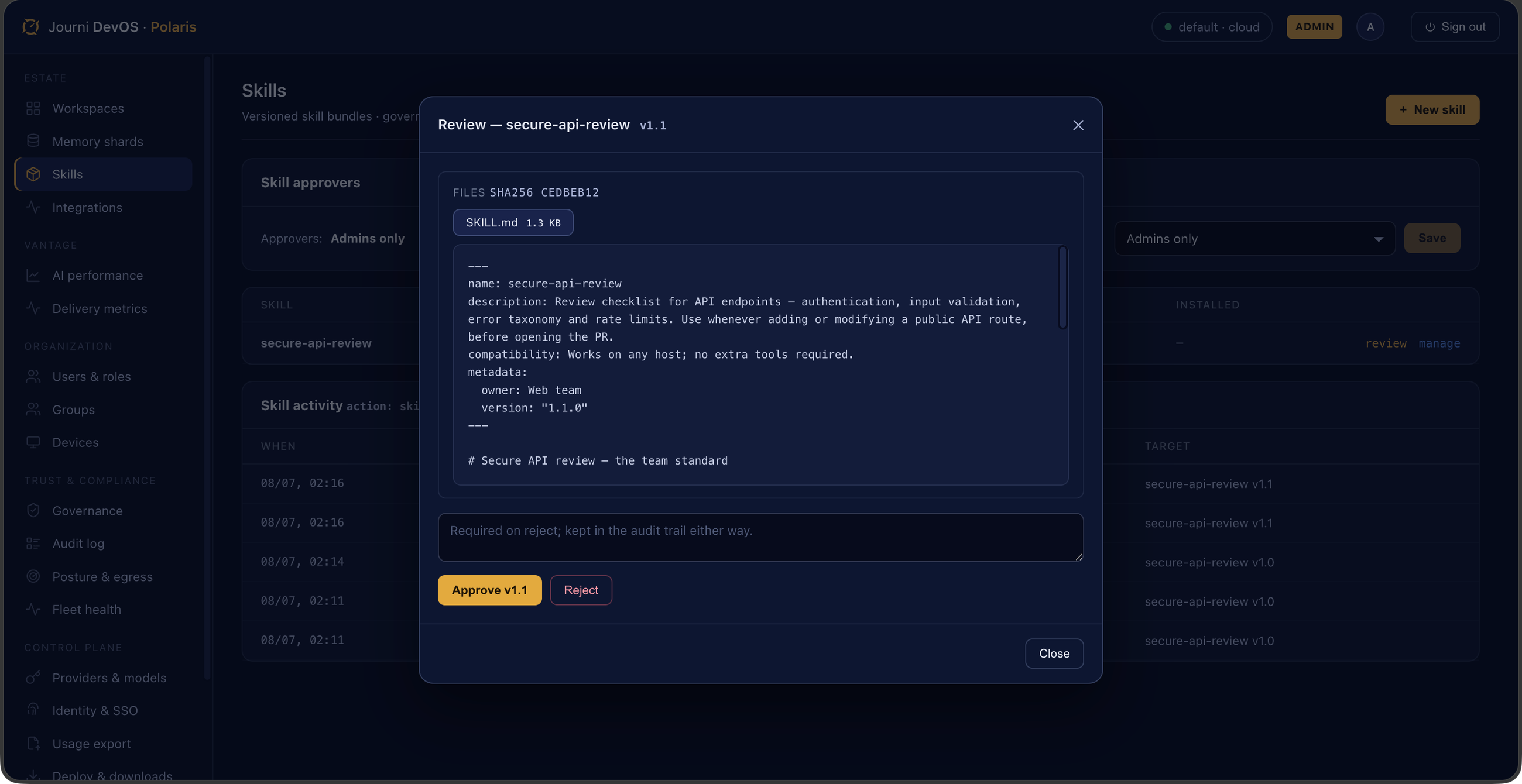
Prove what AI delivers — and catch what it wastes.
A savings statement finance trusts, delivery metrics split by AI-assisted authoring, and deterministic alerts on every session.
Explore Vantage →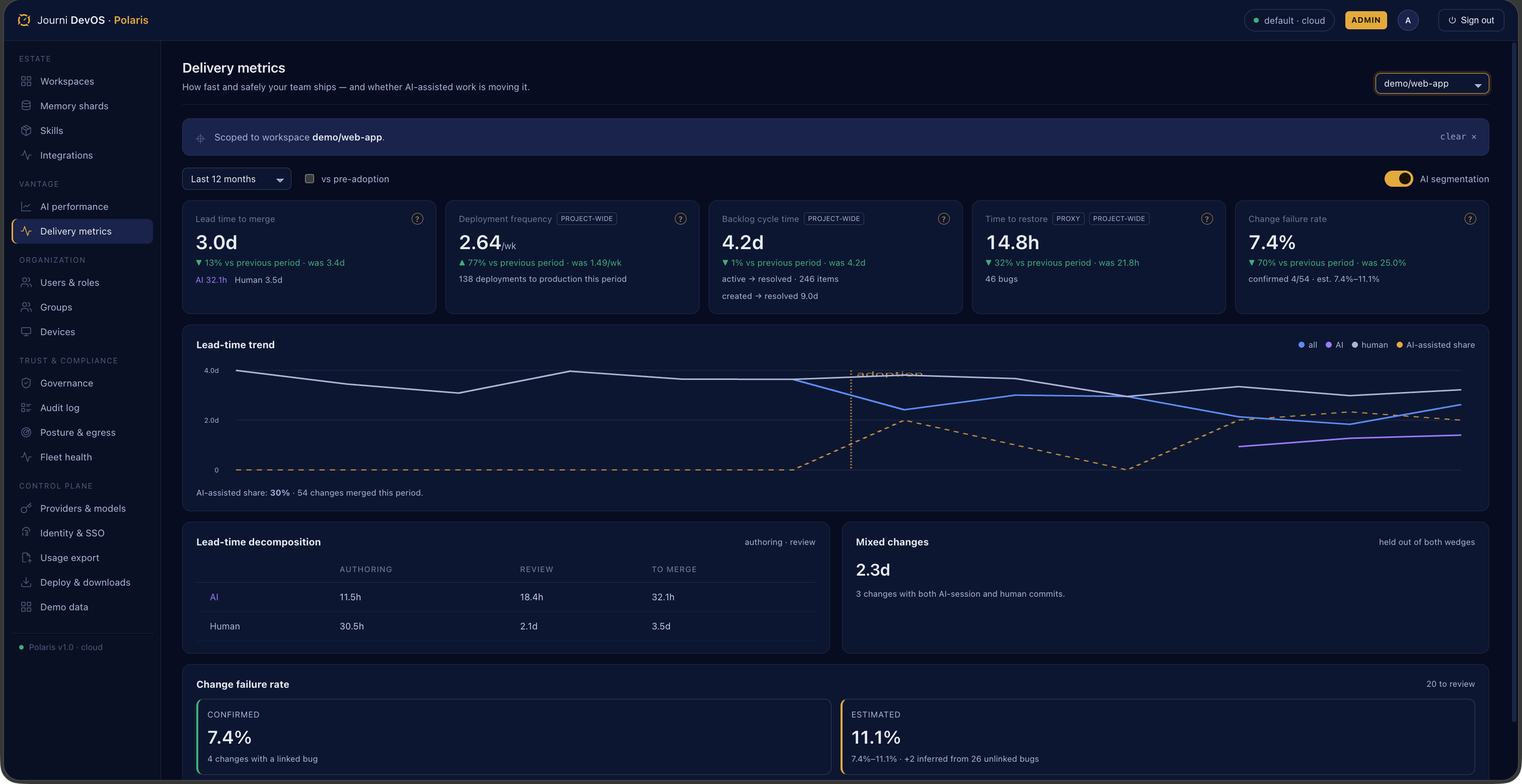
One platform, every view.
Pick a capability and step through its workflows, exactly as your team will run them.
Measured, not claimed.
Efficiency gains come from published benchmark runs on real open-source repositories. Delivery and adoption come from your own pilot — real numbers on your own code, not ours.
Efficiency
Structure-heavy and memory-dependent tasks, run against agents without DevOS: complete refactors, code recall, cost and output. Re-run on public repositories and refreshed periodically.
Delivery, split by AI-assisted
Lead time, deployment frequency and change-failure rate, segmented by AI-assisted authoring. Team-level, against your own baseline — the link between AI adoption and delivery shows up in your own numbers.
Adoption, from the ledger
The share of agent tool-calls routed through DevOS — a real process metric from a DevOS-only pilot, no connector required.
The only layer that governs the agents you already run.
Point tools each cover one slice. Journi DevOS brings governance, memory, skills and measurement into one platform — over the agents your developers already chose.
| Capability | DevOS | Copilot Ent. | Claude Ent. | Augment | Portkey |
|---|---|---|---|---|---|
| Governs the agents you already run | ✓ | ✗ | ~ | ~ | ~ |
| Governed shared memory — shards + RBAC | ✓ | ✗ | ✗ | ~ | ✗ |
| Internal skills marketplace — approval + audit | ✓ | ✗ | ✗ | ~ | ✗ |
| DORA metrics split by AI-assisted authoring | ✓ | ✗ | ✗ | ✗ | ✗ |
| Whole-stack on-prem, air-gap-capable | ✓ | ✗ | ✗ | ✗ | ~ |
| Verified savings ledger | ✓ | ✗ | ✗ | ✗ | ✗ |
Compiled from public sources, 2026. ✓ full · ~ partial · ✗ none. Capabilities change — check current vendor documentation.
Built to pass security review.
Journi DevOS runs inside your own environment, never trains on your data, and isolates every tenant. The controls your security and compliance teams ask for — by architecture, not by promise.
Runs in your perimeter
The control plane self-hosts too. Only aggregated data and a heartbeat leave your boundary — and only if you opt in.
Isolated per tenant
A separate database per tenant — cross-tenant leakage is impossible by construction.
No training on your data
Your code and memory are never used to train anyone's models. Not now, not ever.
Keys in your custody
Provider keys sealed with AES-256-GCM, last-4 only, never written to disk.
Secret redaction
Secrets are redacted fail-closed before any write and at every egress boundary.
Tamper-evident audit
Append-only, hash-chained, with an immutable compliance verdict per session.
Runs where your code already lives.
The only end-to-end on-prem story in AI coding: control plane, memory, metrics — and the agents themselves — all inside your datacentre. Not a VPC tenant on someone else's cloud.
Shipped today, and what's next.
Reflects current intent and is subject to change.
Shipped
- Governed shared memory + restricted shards
- Internal skills marketplace
- Savings ledger & finance-ready statement
- DORA delivery metrics, split by AI-assisted
- SSO, SCIM & enforce-IdP
- Hash-chained audit & compliance verdicts
- Needs-attention alerts — cost, spend, savings, friction, health
- macOS, Linux & Windows support
In build
- Hard policy enforcement on Claude Code
- More alert rules — cache reuse, runaway sessions, off-allowlist, spend jumps
- Memory ingestion from connectors — Azure DevOps, GitHub, Linear and more
- Self-tuning guidance — your AGENTS.md / CLAUDE.md, kept current from your own sessions
Planned
- Support for more agent hosts
- Delivery connectors — GitHub, GitLab, Jira
- MCP tool governance
Questions teams ask.
We only have a handful of developers — is this for us?
Yes. The gaps start with the second agent, not the fiftieth: knowledge that doesn't carry over, spend nobody can see, no shared standard. Journi DevOS earns its place on small teams and scales with you.
Do we have to replace the agents our developers already use?
No. Journi DevOS is a layer over the agents you already run — Claude Code, Codex and any MCP host. Your developers keep their tools; you get governance, memory and measurement across all of them.
Does our code or data leave our environment?
No. Journi DevOS runs inside your own perimeter and never trains on your data. Only aggregated metrics and a heartbeat leave your boundary, and only if you opt in. Air-gapped deployments send nothing at all.
Can we run it fully on-premises?
Yes — the whole stack. Control plane, memory, metrics and the agents all run in your datacentre, air-gap-capable. Not a VPC tenant on someone else's cloud.
How does it enforce policy?
Policy reaches every agent as guidance from day one — no proxy, no heavy install. Where you route agents through Journi DevOS, it's hard-enforced. Either way, every session is classified against the policy in force, on a tamper-evident audit trail.
How is this different from Copilot, Cursor or Augment?
Copilot, Cursor and Augment are AI coding assistants — they help developers write code. Journi DevOS doesn't replace them; it sits above them as an operating layer for the organisation.
By giving AI a persistent shared memory and intelligently managing context, Journi DevOS stops AI assistants from repeatedly rediscovering information they already know. This significantly reduces token consumption and AI costs, while also making developers more productive.
It works with the AI coding tools your teams already use, adding governance, observability, shared memory, productivity metrics and cost reporting — all while running entirely within your own tenant, so your code and data never leave your environment.
The key difference is that Copilot, Cursor and Augment help developers write code. Journi DevOS helps organisations reduce the cost of AI coding, govern its use, and scale it securely across the AI coding assistants your teams use.
What does it cost, and how do we start?
Start with a free pilot on your own codebase — up to three months, measured with your own numbers, before any commitment. Pricing is scoped with you by team size and how you deploy.
Run a free pilot on your own code.
Run Journi DevOS on your codebase for up to three months and measure the impact with your own numbers — before any commitment. Nothing leaves your perimeter.